
An indoor wedding ceremony comes with advantages that outdoor ceremonies cannot match. Predictable weather. Controlled lighting. Climate comfort for every guest. Acoustics that carry vows clearly without wind interference. The trade-off used to be a less photographable backdrop, but venues with floor-to-ceiling windows, architectural features, and waterfront views have closed that gap entirely.
Whether you are planning an indoor ceremony by choice, considering it as a weather backup, or weighing it against an outdoor option, this guide covers the decoration ideas, layout options, lighting setups, and operational details that make an indoor wedding ceremony feel intentional rather than compromised.
Why Couples Choose Indoor Wedding Ceremonies
Indoor ceremonies have grown in popularity for reasons beyond weather:
- Climate control. Guests stay comfortable in any season. Heat, cold, wind, and humidity become non-factors.
- Predictability. No weather contingency planning. The ceremony happens exactly as designed regardless of what the forecast says.
- Better acoustics. Vows, readings, and music carry clearly without wind interference, traffic noise, or open-air sound loss.
- Controlled lighting. Indoor lighting can be designed precisely. Natural light through large windows during the day, then ambient evening lighting after sunset.
- Accessibility. Older guests, guests with mobility needs, and children all manage indoor spaces more comfortably than uneven outdoor terrain.
- Seamless transitions. Ceremony to cocktail hour to reception flows through the same space, eliminating shuttle logistics and guest travel between zones.
- Photography consistency. Indoor lighting stays predictable from start to finish. Photographers can plan exposure and composition without weather variables.
The right indoor venue gives you the visual drama of an outdoor wedding (natural light, waterfront views, architectural detail) without the weather risk.
Indoor Wedding Ceremony Layout Options
The layout shapes everything else about the ceremony: how guests see the couple, how the processional flows, where the photographer positions, how the room reads in photos. A few formats that consistently work indoors:
Traditional Rows
Guests seated in straight rows facing the ceremony focal point, with a center aisle for the processional. The classic format, and the easiest to execute well. Best for ceremonies of 50 to 200 guests.
Circular or Semi-Circular Seating
Seats arranged in a circle or half-circle around the couple. Creates intimacy and lets every guest see the couple’s faces during vows. Works especially well for smaller ceremonies of 30 to 80 guests.
Asymmetrical Layout
Two seating sections offset at an angle, with the ceremony arch or focal point at a corner rather than centered. Photographs dynamically and works well in rooms with architectural focal points (a fireplace, a window cluster, a column).
Window-Facing Setup
The ceremony positioned so guests look out toward a window view (water, garden, skyline) as the backdrop behind the couple. The view becomes part of the ceremony decor without competing with it.
Spiral or Theater-in-the-Round
Seats arranged in a continuous spiral or full circle, with the couple at the center. Most intimate format, best for small intimate weddings of 20 to 50 guests.
At Harbor View Loft specifically, indoor ceremonies can face either the harbor or the marina as the backdrop. The same exact furniture and floral arrangement reads completely differently depending on which direction the aisle faces. Couples often choose based on time of day (harbor at sunset, marina with afternoon light) or personal preference.

Indoor Wedding Ceremony Decoration Elements
Indoor ceremony decor breaks down into a handful of core elements. Each one earns or loses its place depending on the room.
Ceremony Arch or Focal Point
The single most photographed element of the ceremony. Options range widely:
- Floral arch. Two posts connected by an arch or beam, decorated with fresh florals and greenery. The classic choice.
- Asymmetrical arch. Heavy floral on one side, sparse or empty on the other. Reads more modern and photographs more dynamically.
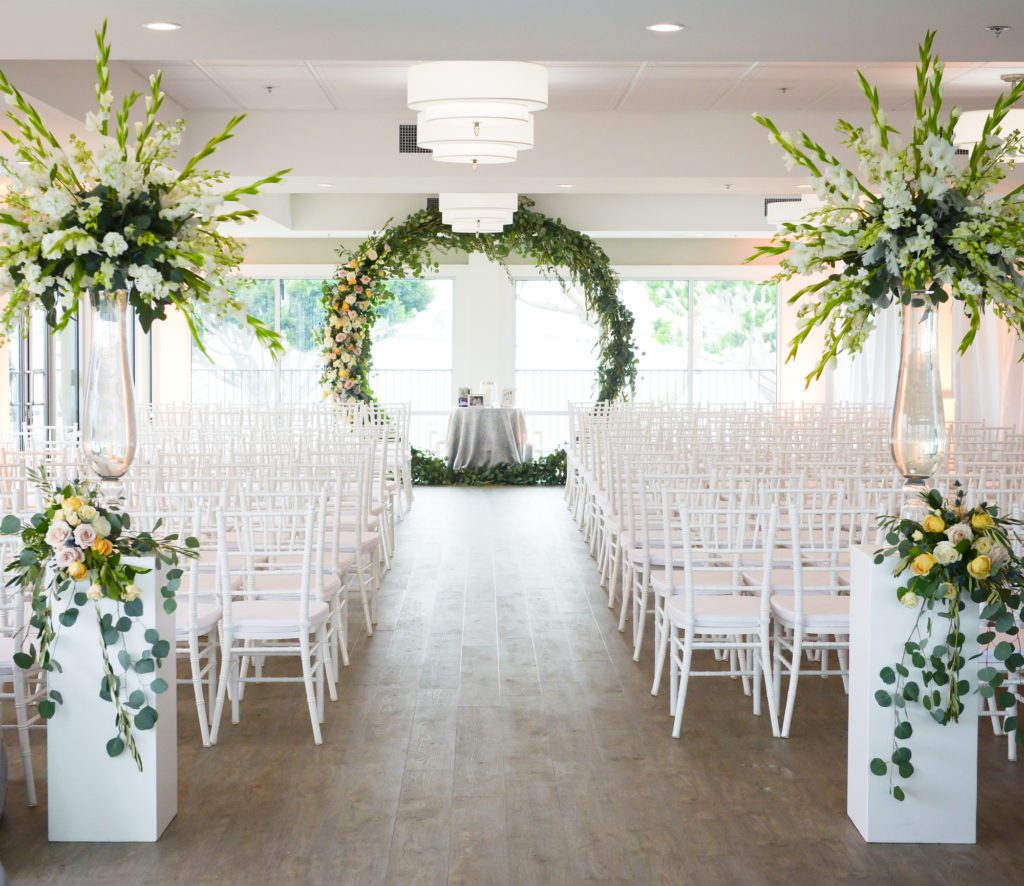
- Circular arch (moon gate). A full circle as the ceremony backdrop. Visually striking and increasingly popular for modern weddings.
- Hanging florals. No physical arch, just floral elements suspended from the ceiling. Lets the architecture and view dominate the frame.
- Window or view as the arch. If the indoor space has a strong window view (water, skyline, garden), skip the arch entirely. The view does the work.
- Statement backdrop. A wall of greenery, a fabric drape installation, or a wood and floral feature. Best for venues without strong natural focal points.
Aisle Decoration
- Petals. Scattered down the aisle or lining the edges. Fresh or freeze-dried.
- Lanterns or pillar candles. Hurricane vases or lanterns at intervals along the aisle. Battery LED candles for safety.
- Greenery runners. Flat greenery (eucalyptus, ferns) running the length of the aisle floor.
- Floral arrangements. Small to medium floral arrangements at every other row or every third row.
- Aisle runner. Fabric runner down the center of the aisle. White is classic; muted colors and patterned runners read more modern.
Ceiling Decor
Indoor ceremonies benefit from ceiling decoration more than outdoor ones because the ceiling is fully visible.
- Hanging florals. Floral clusters or installations suspended above the ceremony space, especially above the couple.
- Greenery installations. Eucalyptus or ivy garlands hung at varied heights.
- Drapery. Fabric drape installations soften industrial or warehouse-style spaces.
- String lights or bistro lights. Especially effective in venues with exposed beams or open ceilings.
- Hanging lanterns or chandeliers. Vintage chandeliers, lantern clusters, or modern statement pendants depending on the aesthetic.
Florals and Greenery
- Bouquets at the altar. Two matching floral arrangements flanking the arch or focal point.
- Bouquet for the officiant area. A small arrangement at the officiant’s stand.
- Aisle arrangements. Small to medium florals at intervals along the aisle.
- Sweetheart arrangement. A small floral piece marking where the couple will stand during vows.
- In-season vs out-of-season. In-season florals cost less and read more natural. A summer ceremony with peonies feels different than a winter ceremony with amaryllis and evergreen.
Candles and Lighting
- Pillar candles at the altar. Cluster of mixed-height pillars on either side of the couple. Real flame for indoor ceremonies, battery LEDs near drafty windows or open doors.
- Aisle lanterns. Glass hurricane lanterns at intervals down the aisle.
- Uplighting on walls. Color-changing LEDs at the base of walls create dramatic depth, especially during evening ceremonies.
- String lights. Warm white string lights softening any indoor space.
- Spotlights on the couple. Subtle spotlight or focused lighting on the ceremony arch ensures photos and videos capture the couple clearly.


Indoor Wedding Ceremony Lighting
Lighting is the difference between an indoor ceremony that photographs beautifully and one that feels flat. A few principles:
- Time the ceremony around natural light. Indoor ceremonies in venues with large windows look best 1 to 2 hours before sunset. Afternoon light through windows is the most flattering ambient light source available.
- Layer artificial and natural light. Even with great natural light, supplemental warm lighting (string lights, candles, uplighting) prevents dark corners and shadows.
- Warm white, not cool white. Every artificial light source should be warm white. Cool white reads clinical in photos.
- Avoid mixed color temperatures. Color-changing lights for the reception, single warm tone for the ceremony.
- Light the aisle, not just the altar. The processional needs visible aisle lighting (lanterns, candles, soft uplights) so the couple and wedding party walk through visible light, not into shadow.
- Plan for the sunset transition. If the ceremony spans sunset, the lighting needs to shift from natural to artificial without an awkward dim middle period. Discuss this transition with the venue and photographer in advance.
Color Palette and Themes for Indoor Wedding Ceremonies
Indoor ceremonies have more flexibility with color palette than outdoor ones because there is no landscape to coordinate with. A few themes that work especially well:
- Classic white and greenery. White florals, fresh eucalyptus, and ivory aisle decor. Timeless and photographs cleanly in any light.
- Soft neutrals. Cream, blush, dusty rose, and sage. Reads contemporary without committing to a specific era.
- Bold jewel tones. Burgundy, emerald, navy, or deep purple as accent colors against neutral linens. Best for fall and winter weddings.
- All white. Florals, candles, aisle runner, even the chairs in white. Reads dramatic and modern, especially against architectural venues with strong natural light.
- Coastal. Soft blues, white, and natural materials (driftwood, rattan, jute). Pairs naturally with waterfront and harbor venues.
- Black tie elegance. Deep burgundy, gold accents, taper candles in candelabras, and heavy florals. Best for formal evening ceremonies.
- Modern monochrome. A single accent color (deep red, dusty pink, midnight blue) used aggressively against a white base.
Indoor vs. Outdoor Wedding Ceremony
The right answer depends on the venue, season, and personal priorities. A quick decision framework:
- Choose indoor if: The weather is unpredictable, the season is cold or hot, you have older guests or accessibility considerations, you want predictable lighting for photos, the indoor space has its own architectural or view appeal, or you value the climate control for guest comfort.
- Choose outdoor if: You are getting married in a reliably mild season at a venue with stunning natural backdrop, you have a flexible photography style that adapts to changing light, you have an indoor backup plan you would actually be happy with, or the venue’s strongest feature is genuinely outdoor.
- Best of both worlds: Venues with floor-to-ceiling windows, indoor-outdoor flow, or covered patios let the ceremony happen indoors while the backdrop reads as outdoor. This is increasingly how couples plan ceremonies at modern wedding venues.

Using an Indoor Ceremony as a Weather Backup
Even couples committed to outdoor ceremonies need a real indoor backup plan. A few principles for the backup:
- Plan the indoor version completely. Layout, decor, lighting, processional path. Treat the backup as a real possibility, not an afterthought.
- Set a decision deadline. Decide the morning of the wedding (typically 6 to 8 hours before the ceremony) rather than mid-event. Last-minute pivots stress everyone and produce sloppy execution.
- Brief vendors on both versions. Florists, photographers, musicians, and the venue team should all know how the ceremony shifts indoors. Florals stay the same but installation locations move. Music levels adjust for room acoustics. Photographer’s positions shift entirely.
- Communicate clearly with guests. If the backup activates, signage and ushers should redirect guests calmly. Guests reading the situation from social cues escalates stress.
- Make the indoor version genuinely beautiful. If the backup feels like a compromise, the day suffers. The best backups feel like an equally good Plan A, not a Plan B.

Common Indoor Wedding Ceremony Mistakes to Avoid
- Ignoring sight lines. Floral arrangements taller than 24 inches in front of the couple block the view from the back rows. Centerpieces work differently than ceremony florals.
- Over-decorating a beautiful room. Venues with strong architectural detail or window views can be undone by adding too much decor that competes with the existing features. Edit aggressively.
- Mismatching the lighting. Mixing color-changing reception lights with the ceremony lighting reads accidental. Keep the ceremony lighting cohesive and shift to color for the reception.
- Forgetting the ceiling. Indoor ceremonies make the ceiling fully visible in every photo. Leaving it bare is a missed opportunity.
- Skipping the photographer walkthrough. Indoor ceremonies have very specific best photo positions. Walk the room with your photographer in advance to plan their angles around the layout.
- Treating it like a smaller version of an outdoor wedding. Indoor ceremonies have their own design logic. The decor that works on a windswept beach reads differently in a windowed loft.
Indoor Wedding Ceremonies at Harbor View Loft
The indoor ceremony space at Harbor View Loft works because of three architectural features: wall-to-wall windows facing both the harbor and the marina, an open floor plan that accommodates seating arrangements from 30 to 200 guests, and natural light that shifts dramatically through the afternoon and evening.
Couples typically choose the harbor as the ceremony backdrop for sunset ceremonies (golden light pouring through the windows directly behind the couple) or the marina for afternoon ceremonies (softer light from the side). The arrangement is the same; the aisle direction flips. Couples often decide during their walkthrough which view they want as their backdrop.

Our team works with couples to design the indoor ceremony layout alongside the rest of the wedding planning, including chair styling, aisle decor, floral installation positions, and lighting transitions through the ceremony. See more on our wedding venue page, or contact us to schedule a tour.
Frequently Asked Questions
What is the best layout for an indoor wedding ceremony?
Traditional rows with a center aisle work for the widest range of ceremonies (50 to 200 guests). Circular or semi-circular seating creates more intimacy for smaller ceremonies (30 to 80 guests). Asymmetrical layouts and window-facing setups work well in venues with strong architectural features. The right layout depends on guest count, room shape, and where the most photogenic backdrop is.
How do you decorate an indoor wedding ceremony?
The five core elements are the ceremony arch or focal point, aisle decoration, ceiling decor, florals at the altar, and lighting. Most well-decorated indoor ceremonies use a combination of all five, with one element (typically the arch or a hanging floral installation) as the primary statement piece. Edit aggressively in venues with strong architectural features that already do visual work.
How much do indoor wedding ceremony decorations cost?
Decoration costs vary widely based on floral volume, lighting design, and rental items. A simple indoor ceremony with one floral arch, basic aisle decor, and venue-provided seating typically runs $1,500 to $4,000. A more elaborate setup with hanging florals, custom lighting, and full aisle installations runs $5,000 to $15,000 or more. Florals are usually the largest line item.
What lighting is best for an indoor wedding ceremony?
Layer natural light with warm artificial lighting. Time the ceremony 1 to 2 hours before sunset to maximize natural light through windows. Add warm white string lights, pillar candles, and subtle uplighting for depth. Avoid cool white bulbs, mixed color temperatures, and color-changing lights during the ceremony itself. Keep color-changing or dramatic lighting for the reception.
Can you have an outdoor ceremony move indoors as a backup?
Yes, and any outdoor ceremony plan should include a real indoor backup. Plan the indoor version completely (layout, decor positions, lighting), set a decision deadline 6 to 8 hours before the ceremony, brief all vendors on both versions, and make the indoor version genuinely beautiful so it does not feel like a compromise. Venues with both indoor and outdoor ceremony options simplify the logistics substantially.
What is the difference between an indoor and outdoor wedding ceremony?
Indoor ceremonies offer climate control, predictable lighting, better acoustics, and seamless flow into the reception. Outdoor ceremonies offer natural backdrop drama and an open-air atmosphere, but come with weather risk and harder lighting variables. Venues with floor-to-ceiling windows or covered indoor-outdoor flow give the visual feel of an outdoor ceremony with the practical advantages of indoor.
How early should I plan indoor wedding ceremony decorations?
Book the florist and rental items 8 to 12 months before the wedding. Finalize specific arrangements and quantities 60 to 90 days before. Walk the venue with your florist and photographer 30 days before so installation positions, photo angles, and lighting setup are coordinated. Last-minute decoration changes are the most stressful and expensive way to plan.
Planning Your Indoor Wedding Ceremony
If you are considering an indoor wedding ceremony at Harbor View Loft, our coordinators can walk through layout options, decor positioning, and lighting transitions during your venue tour. The room transforms substantially depending on which direction the aisle faces and what time of day the ceremony is held. Contact us to schedule a tour.
Floral Arrangements by My Splendid Sentiments
Photographer: Half Full Photography
Management and Catering of Harbor View Loft by Personal Touch Dining
